Residence card and work permit: when you need a lawyer with a licence
At the office anyone can act for you, before a court only an adwokat or radca prawny. And see why handing your case to an employer can cost you the application.

Applying for a residence card or a work permit and wondering whether you need a lawyer? At the office — no. Any adult can act as your representative there. But there are two moments when nothing can be done without an adwokat or a radca prawny — and one decision that can wipe out your whole application. Here is who may represent you at each stage of a foreign national’s case, and what in practice separates those two professions.
Both titles are regulated Polish legal professions. There is no exact English equivalent, so we keep the Polish names.
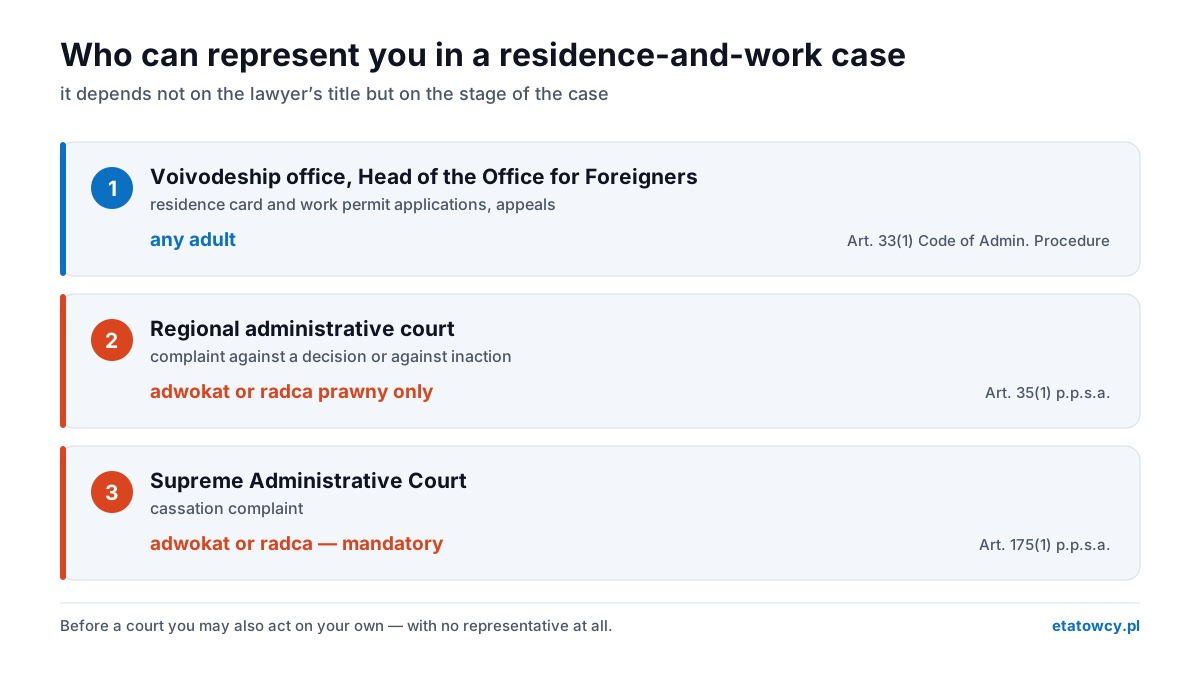
Stage 1: the voivodeship office and the Office for Foreigners — anyone may represent you
This is where most cases take place: an application for a temporary residence permit, a permanent residence permit, a residence card, a work permit, and an appeal to the Head of the Office for Foreigners.
Under Art. 33(1) of the Code of Administrative Procedure, a party’s representative may be any natural person with legal capacity. That is all. They need not be an adwokat, a radca prawny, or even a lawyer. It may be a lawyer without a bar entry, an employment agency’s staff member, a friend or a family member.
One practical difference does exist. An ordinary representative must file the original power of attorney or an officially certified copy, while an adwokat, radca prawny, patent attorney or tax adviser may certify the copy themselves (Art. 33(3)). In practice that means fewer trips to a notary.
Remember the stamp duty on the power of attorney — it is paid separately when the document is filed.
The most important advice: do not hand your case to your employer or agency
This is the mistake that costs the most — and a great many foreign nationals make it. The employer or the agency offers: “we will file the application for you, we will take care of everything”. You sign a power of attorney and lose control of your own case.
Why is that dangerous? Because from that moment the office no longer writes to you. Under Art. 40(2) of the Code of Administrative Procedure, where a party has appointed a representative, documents are served on the representative. Summonses, notices, decisions — everything goes to the agency. You receive nothing and may not even know the office wants something from you.
As long as the relationship is good, usually nothing bad happens. The trouble starts the moment you change employer. The agency no longer has any interest in your case. The envelope from the office ends up in a drawer and nobody tells you about it.
That sets off a chain that ends the case:
- The office calls for missing documents and sets a deadline — no shorter than 7 days (Art. 64(2)).
- The summons goes to the representative, that is, to your former agency. You know nothing about it.
- The deadline passes.
- The application is left without examination. It is not decided — it simply ceases to exist.
- And with it goes the legal basis for your stay that filing the application on time had given you.
You usually find out months later — during a check, when trying to travel, or when a new employer asks for documents.
Can it be undone? Sometimes, but it is hard. A request to restore the deadline must be filed within 7 days of the cause ceasing, together with the omitted action, and above all you must show that the failure happened through no fault of your own (Art. 58(1) and (2)). The fact that a representative did not pass on the letter will not always count as absence of fault — after all, you chose that representative. The deadline for filing the request itself cannot be restored (Art. 58(3)).
How to protect yourself:
- Do not give a power of attorney to anyone dependent on your employer. If you want a representative, choose someone unconnected with the company that employs you.
- Or run the case without a representative — then all correspondence goes to your address and nothing passes you by.
- You may revoke a power of attorney at any time. A written statement filed with the case records is enough. From then on, letters come back to you.
- Keep your address current. Report every change to the office — if you neglect this, service at the old address is as effective as if you had collected the letter (Art. 41).
- After changing employer, check who is on file as your representative. If it is the former agency, revoke the power of attorney at once — do not wait.
Help from an employer in gathering documents is a good thing. But the signature on the application and the address for correspondence should stay yours.
Stage 2: a complaint to the regional administrative court — only an adwokat or radca prawny
Here the rule changes. If, after a decision of the Head of the Office for Foreigners, you go to court — or you challenge the inaction of an office that has not dealt with your application for months — only an adwokat or a radca prawny may represent you before the regional administrative court. Also admitted are another complainant or participant in the proceedings, a spouse, siblings, ascendants and descendants, and persons in an adoptive relationship (Art. 35(1) of the Law on Proceedings before Administrative Courts).
A lawyer without a bar entry cannot represent you here. They may, however, prepare the complaint for you to sign and file yourself — before this court you may act in your own name with no representative at all.
Stage 3: cassation complaint to the Supreme Administrative Court — compulsory
At this stage there is no choice. A cassation complaint to the Supreme Administrative Court must be drafted by an adwokat or a radca prawny (Art. 175(1)). The exceptions cover a narrow group — judges, prosecutors, notaries, and professors and habilitated doctors of law who are themselves a party or a representative.
A cassation complaint written on your own will be rejected, however sound its arguments.
Adwokat or radca prawny — does it matter in a foreigner’s case?
The short answer: no. Since 1 July 2015 the powers of both professions have been almost identical. Both may advise, draft documents and appear before courts and administrative authorities. In residence and employment cases of foreign nationals there is no difference in what they are allowed to do.
The three real differences concern other things:
| Adwokat | Radca prawny | |
|---|---|---|
| Employment contract | not allowed (except academic work) | allowed — in a company, bank or public office |
| Defence in criminal cases | always | yes, unless employed under a contract of employment |
| Professional body | bar associations, Polish Bar Council | district chambers, National Bar of Legal Advisers |
The colour of the jabot on the gown also differs — green for adwokaci, blue for radcowie. For your case that means nothing at all.
What does matter is the professional body: two separate registers and two disciplinary tracks. That is where you check whether the person you are trusting really holds the licence — and where you would file a complaint if something went wrong. Fees do not depend on the title.
What to look at when choosing
In cases involving foreign nationals, experience in these particular matters decides, not the title. A commercial-law specialist will not guide you smoothly through an application for a temporary residence and work permit, just as a divorce specialist will not help with an appeal against a voivode’s decision.
Before you trust someone, check:
- whether they hold the licence they claim — adwokaci appear in the register kept by the Polish Bar Council, radcowie prawni in the register of the National Bar of Legal Advisers,
- whether they have run cases like yours — ask directly about proceedings before the same voivodeship office,
- what exactly the contract covers — only drafting the application, or also representation and watching the deadlines,
- who will sign the court filing if the case goes that far.
Beware of people who present themselves as “immigration advisers” and promise a positive decision. No one can guarantee the outcome of proceedings — not an adwokat, not a radca prawny, no one.
What this means for you
If you are a foreign national:
- Do not sign a power of attorney for your employer or a work agency. After you change jobs they receive the summonses from the office and you may never hear of them — and you lose the application.
- Residence card application, work permit, appeal to the Head of the Office for Foreigners — any adult may act as your representative. Do not overpay for a title where it is not required.
- Going to an administrative court? You need an adwokat or a radca prawny — or you act on your own, possibly with help from a spouse or sibling.
- A cassation complaint without one of them will be rejected. There is no shortcut here.
- Check the licence in the chamber’s register before you sign a contract and pay.
If you employ foreign nationals:
- Applications and correspondence with the office can be handled by your own employee as representative — a written power of attorney is enough.
- If the case reaches a court, you will need an adwokat or a radca prawny. Worth planning for, because the deadline for a complaint is short.
- Where proceedings drag on, first comes a formal reminder to the higher authority — the court route follows.
Have a case at a voivodeship office and are unsure whether it was handled correctly? Write to us — we reply within one business day, in Polish, English and Spanish. We handle cases before the voivode and the Head of the Office for Foreigners; if a case needs the court route, we will tell you plainly at which point an adwokat or radca prawny becomes necessary.
Based on: Act of 14 June 1960 — Code of Administrative Procedure (consolidated text, Dz.U. 2025 item 1691), Art. 33, 40, 41, 58 and 64; Act of 30 August 2002 — Law on Proceedings before Administrative Courts (consolidated text, Dz.U. 2026 item 143), Art. 35 and Art. 175. Information on the differences between the two professions after “Adwokat czy radca prawny? Do kogo się zwrócić i czym różnią się ich uprawnienia?”, Aleksandra Gruszczyńska, Gazeta Prawna, 14 October 2026. Legal status as at 16 October 2026. This article is for information only and is not legal advice in an individual case.