The shortage list has halved. And transport is still 100,000 drivers short
The 2027 forecast leaves 14 shortage occupations instead of 28 three years ago. It does not mean workers have appeared — see what actually changed.
Three years ago the barometer listed 28 occupations in which employers could not find anyone to hire. The 2027 forecast leaves 14. Except this is not the good news it looks like — the list has shrunk partly because employers are reporting 41 per cent fewer vacancies to labour offices than a year ago. At the same time transport is short of 100,000 drivers, and industry experts point to a specific cause that has nothing to do with demographics: drawn-out visa and residence procedures. Here is where it is worth looking for work today, and what the route to legally employing a foreign national in such a sector looks like.
Where the barometer comes from
The Occupational Barometer (Barometr zawodów) is a qualitative study, not statistics pulled from registers. It is produced separately for every county (powiat) in Poland by panels of experts — staff of county labour offices, private employment agencies and other labour-market institutions. They meet at the turn of the third and fourth quarter and assess 168 occupations derived from the Classification of Occupations and Specialisations. The list of occupations is updated once a year.
Each occupation lands in one of three categories:
- shortage — more vacancies than candidates,
- balanced — the numbers are close,
- surplus — more candidates than vacancies.
The study is coordinated by the Regional Labour Office in Kraków, and since 2020, by decision of the Ministry of Family, Labour and Social Policy, it has been merged with the Monitoring of Shortage and Surplus Occupations into a single study. It is financed from the Labour Fund.
Worth understanding before you look at the numbers: “shortage” does not mean “well paid” or “easy to get into”. It means that locally a candidate is harder to find than a vacancy.
14 occupations, seven sectors
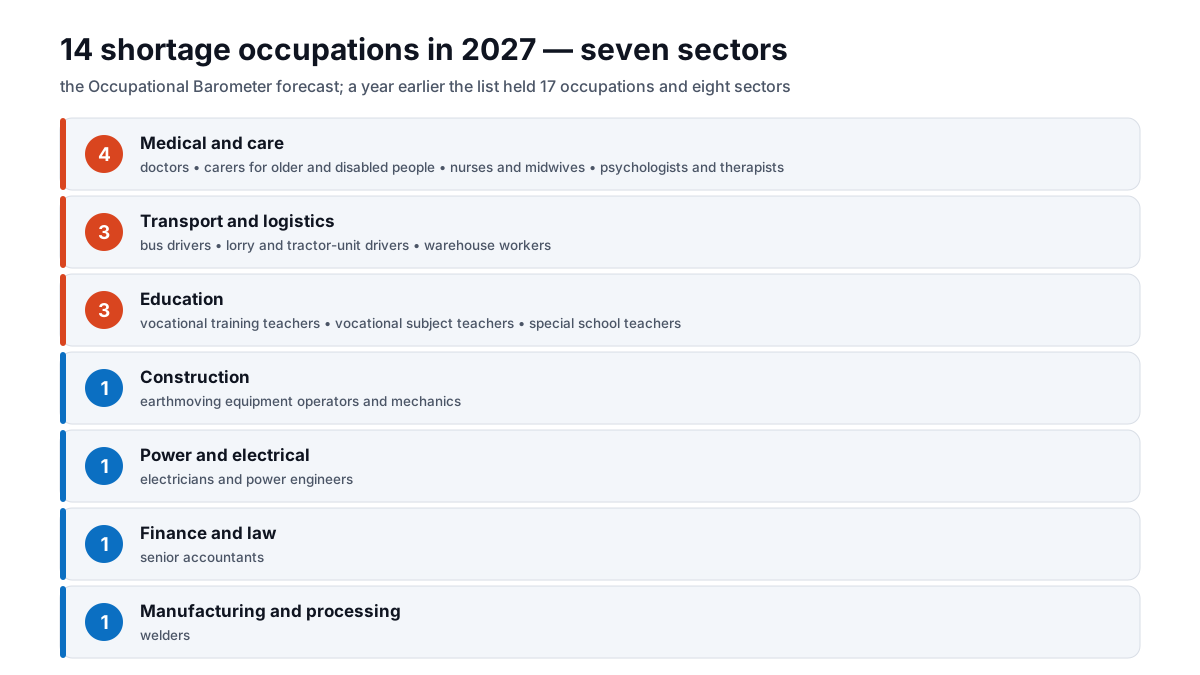
The 2027 forecast identifies 14 shortage occupations across seven sectors. A year earlier there were 17 across eight sectors; in the 2025 forecast 23; and in the 2024 barometer 28. Over three years the list has halved.
| Sector | Shortage occupations in 2027 |
|---|---|
| Medical and care | doctors, carers for older and disabled people, nurses and midwives, psychologists and therapists |
| Transport and logistics | bus drivers, lorry and tractor-unit drivers, warehouse workers |
| Education | vocational training teachers, vocational subject teachers, special school and integration class teachers |
| Construction | earthmoving equipment operators and mechanics |
| Power and electrical | electricians and power engineers |
| Finance and law | senior accountants |
| Manufacturing and processing | welders |
Three occupations dropped off the list this year: uniformed services staff, teachers of general subjects and foreign languages, and building installation fitters. A whole sector also disappeared — security and protection, which was still on the list a year ago.
Why the list is shrinking — two very different reasons
The first is encouraging. Krzysztof Inglot, a labour-market expert and founder of Personnel Service, points to a change of approach to education after Poland noticed its growing shortages of specialists. He cautions, though, that the reform has not removed the problem, because employers are still struggling with a mismatch between qualifications and their needs. He speaks plainly of “an improvement in the situation, not an end to the problem”.
The second reason is altogether different: there are simply fewer vacancies. According to GUS data cited by the expert, between January and September 2026 some 325,800 vacancies were reported to labour offices — 41.1 per cent fewer than in the same period of 2025. Fewer vacancies mean fewer shortages revealed. An occupation does not stop being hard to fill just because nobody is recruiting.
Unemployment is nonetheless not rising dramatically, and the reason is demographic: forecasts suggest that from 2027 the labour market will lose 100,000 people a year. In other words demand and supply are shrinking at once, and today’s trend may well hold in the years ahead.
Drivers: 100,000 missing, and the procedures that keep them missing
The most interesting case — and the one closest to our readers — is transport. Andrzej Szymański, managing director of DARTOM, speaks of a shortfall of 100,000 drivers in Poland. Older drivers are retiring or going onto disability pensions, young people are not drawn to the job, and recruiting specialists from other markets “borders on a miracle”.
Maciej Wroński, president of the Transport and Logistics Poland employers’ association, names the cause of that last point without hedging: the blame lies with drawn-out administrative procedures, which have left potential workers from the East stuck in dead visa and residence proceedings. You can see the result in the yards outside companies — lorries parked up with nobody to drive them, even though demand for haulage is growing.
That is the heart of the matter for anyone planning work or recruitment in Poland: in some occupations the bottleneck is not a lack of willing people but the wait for documents. So it is worth knowing what that route looks like and where it usually jams.
Work permit and residence card — how it works since June 2025
If you are a non-EU national and want to work in one of the shortage occupations, two separate documents are usually in play.
The work permit (zezwolenie na pracę) is obtained by the employer, not by you — the employer is the applicant and the party to the proceedings. Since 1 June 2025 the Act of 20 March 2025 on the conditions for entrusting work to foreign nationals has applied, and it changed something fundamental: under its Art. 8(2) and (3) the application and documents are filed solely through the ICT system (praca.gov.pl), and an application filed by any other route is left without examination. The same goes for appeals — lodging one by another route is simply inadmissible.
And here is where many employers and representatives stumble. Applications, appeals, attachments and digital copies of documents must be signed with a qualified electronic signature, a trusted signature (podpis zaufany) or a personal signature. Without one of these, the proceedings cannot even start. If you do not yet have a Trusted Profile, start there — we have described it step by step in a separate guide: Trusted Profile — how to register.
The work permit fee depends on the type: PLN 200 for up to 3 months, PLN 400 for more than 3 months, PLN 800 for posting by a foreign entity and PLN 100 for seasonal work. The employer pays it.
The residence card is an entirely different matter and separate proceedings — conducted by the voivode, with you as the applicant. The most common variant for people in work is the temporary residence and work permit (stamp duty PLN 440), and once the decision is issued there is a further, separate fee of PLN 100 for issuing the card itself. A residence card bearing the annotation “access to the labour market” also opens up benefits that a visa alone does not give.
Two things to keep in mind before you start: the work permit and the residence card are two independent sets of proceedings, and the fees for them go to three different accounts. And second: a power of attorney in a residence case costs PLN 17 per representative — left unpaid, it can sink the whole application.
What this means for you
If you are looking for work:
- The fourteen occupations on the list are where your qualifications carry real bargaining power — especially C+E lorry driver, welder, carer for older people and electrician.
- Before you invest in a course, check the situation in your own county: the barometer is produced locally, and an occupation in shortage in one county may be balanced in the next.
- A shorter shortage list means that in all the other occupations the market has tilted towards the employer. You will wait longer for a reply to an advertisement than you would have a year ago.
- A foreign national? Set up a Trusted Profile before you start arranging anything. Without it you cannot sign documents in work permit proceedings, nor handle most matters online.
If you are hiring:
- In transport, care work and welding, do not count on a candidate turning up “once recruitment starts” — in these occupations recruitment takes longer than the legalisation procedure, and both have to run in parallel.
- A work permit application filed on paper or by post will be left without examination. Make sure the person representing the company has a trusted or qualified signature before you start assembling documents.
- Plan with time to spare. Transport industry representatives point squarely at residence procedures as the cause of the driver shortage, not at a lack of willing workers.
- The work permit fee is paid by the entity entrusting the work. Do not pass it on to the employee or deduct it from wages.
Need to work out which legalisation route fits a particular post, or where your application has stalled? Write to us — we reply within one business day, in Polish, English and Spanish. We handle cases before the voivode and the Head of the Office for Foreigners.
Based on: the Occupational Barometer — 2027 forecast, a study coordinated by the Regional Labour Office in Kraków and financed from the Labour Fund; the methodology (168 occupations under the Classification of Occupations and Specialisations, expert panels at the turn of Q3 and Q4, a forecast produced separately for each county, three assessment categories, merged with the Monitoring of Shortage and Surplus Occupations since 2020 by decision of the Ministry of Family, Labour and Social Policy) after barometrzawodow.pl. The 2027 figures, the lists of sectors and occupations and the comments of Krzysztof Inglot, Andrzej Szymański and Maciej Wroński after the article “Ubywa zawodów deficytowych. W ciągu roku z listy zniknęły trzy profesje”, Patrycja Otto, Gazeta Prawna, 12 November 2026; the vacancy data after GUS, as cited in that article. Legislation: Act of 20 March 2025 on the conditions for entrusting work to foreign nationals in the territory of the Republic of Poland (Dz.U. 2025 item 621), Art. 8(2), (3), (4) and (8) — in force since 1 June 2025; regulation of the Minister of Family, Labour and Social Policy of 20 November 2025 on fees (Dz.U. 2025 item 1622); Act of 16 November 2006 on stamp duty (consolidated text, Dz.U. 2026 item 1395), Annex. We did not download the full 2027 forecast table from barometrzawodow.pl, because while this text was being prepared some of the site’s modules were switched off for modernisation. Legal status as at 13 November 2026. This article is for information only and is not legal advice in an individual case.