
Entering Poland to cost four times more — PLN 300 for each day
The ministry wants to raise the amount required at the border from PLN 75 to PLN 300 a day. See who is affected and how paid accommodation lowers it to PLN 130.
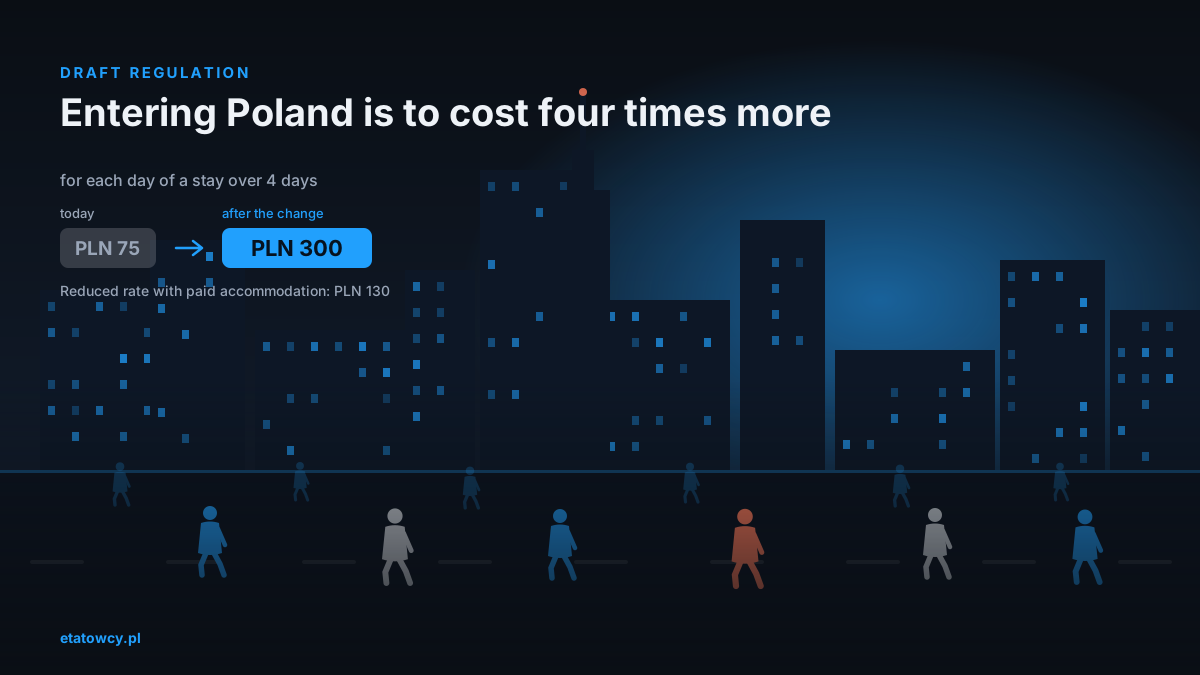
A foreign national coming to Poland for two weeks will have to carry PLN 4,200 instead of today’s PLN 1,050. The Ministry of the Interior and Administration (MSWiA) has sent for consultation a draft that quadruples the amounts required at the border. Here is who it covers, who it leaves out, and why for people arriving for work everything turns on who pays for the accommodation.
What changes
The draft amends a regulation of 23 February 2015, which has set the financial thresholds at the border for ten years. The new amounts:
| Situation | Today | After the change |
|---|---|---|
| Stay of up to 4 days | PLN 300 | PLN 1,000 |
| Each day of a stay over 4 days | PLN 75 | PLN 300 |
| Reduced rate — per day | PLN 20 | PLN 130 |
| Reduced rate — minimum total | PLN 100 | PLN 650 |
| Studies, training, research — first 2 months | PLN 1,270 | PLN 2,020 |
The money may be held in zloty or the equivalent in a foreign currency. The regulation is to enter into force 30 days after publication — and since it is only at the consultation stage, that is at least several weeks away.
Who pays less: the reduced rate
This is the part that matters most to people coming to work through an agency. The reduced rate — PLN 130 a day after the change, no less than PLN 650 in total — applies to four groups:
- participants in package tours, youth camps and sporting events,
- people whose costs of stay in Poland have been paid,
- patients travelling to medical and sanatorium facilities,
- participants in international working-holiday programmes, provided work is not the main purpose of the trip.
The second item is exactly the case of a worker whose agency or employer provides accommodation and meals. The evidence is a document confirming payment of the costs of stay, covering at least accommodation and meals. Over a two-week stay the difference is PLN 4,200 against PLN 1,820 — more than two and a half times less.
Note: having your accommodation paid does not remove the need to carry money. The explanatory memorandum states plainly that cover for additional or unforeseen expenses is still needed — which is why the reduced threshold also rises, from PLN 20 to PLN 130.
What the draft does not change
Separately from the funds for the stay, a foreign national without a return ticket must have money for the journey home — equal to the value of the ticket they arrived on, but no less than:
- PLN 200 — arriving from a country bordering Poland,
- PLN 500 — from another European Union country,
- PLN 2,500 — from a country outside the Union.
The draft leaves these untouched. They must be held on top of the funds for the stay.
The money need not be in cash. Travellers’ cheques, a bank statement of a credit-card limit and a certificate of funds held in a bank or credit union account all count as proof.
Why now
The ministry gives two reasons.
Inflation. The amounts have not changed since 2016. According to Statistics Poland (GUS) data cited in the memorandum, cumulative inflation in 2016–2025 reached about 56.6%, with the sharpest rises in 2022 (14.4%) and 2023 (11.4%), and 3.6% in both 2024 and 2025. At today’s cost of accommodation and food, PLN 75 a day no longer matches what it takes to live.
Schengen. The Schengen Borders Code requires a foreign national entering for up to 90 days in any 180-day period to show sufficient means of subsistence, and states are to assess them against average prices for inexpensive accommodation and food (Art. 6(1)(c) and 6(4) of Regulation 2016/399). Poland’s PLN 75 is the equivalent of EUR 17–18 — well below its neighbours:
| Country | Daily threshold |
|---|---|
| Bulgaria, Lithuania | EUR 50 |
| Slovakia | EUR 56 |
| Czechia | approx. EUR 64 |
| Croatia, Slovenia, Estonia | EUR 70 |
| Portugal | EUR 75 |
The proposed PLN 300 is about EUR 70 — close to countries with a similar price structure.
The higher threshold for students and researchers has a different origin. In 2015 the figure of PLN 1,270 was calculated as double the income criterion for a single-person household, then PLN 634. As the criterion has risen to PLN 1,010, the ministry applied the same mechanism: 2 × PLN 1,010 = PLN 2,020.
What this means for you
If you are coming to work:
- Check whether your employer or agency provides accommodation and meals — and ask for the document that confirms it. It decides whether the border rate for you is PLN 300 a day or PLN 130.
- Count your stay to the day you plan to leave, not to the end of your visa. The Border Guard calculates funds for the planned stay.
- Without a return ticket, the cost of the journey home is added — up to PLN 2,500 when arriving from outside the Union.
- The funds need not be cash: a bank certificate of your balance or of your card limit is enough.
- The change is not yet in force. Until the new regulation takes effect, PLN 75 a day applies.
If you employ foreign nationals:
- If you provide accommodation, issue workers a document confirming payment of the costs of stay, covering accommodation and meals. Without it the full rate applies at the border.
- Recalculate how the change affects the cost of bringing in a worker who funds the trip themselves — over a month that is a difference of around PLN 6,750.
- The change concerns entry, not the legality of work. Permits, declarations and residence titles are unaffected.
- The draft is in consultation — the amounts may still change before publication.
Not sure whether your workers will cross the border with the right set of documents — or planning the trip yourself? Write to us. We reply within one business day, in Polish, English and Spanish.
Based on: draft regulation of the Minister of the Interior and Administration amending the regulation on funds required from a foreign national entering the territory of the Republic of Poland (MSWiA legislative work list no. 1351, published on gov.pl on 14 October 2026, documentation in the Public Information Bulletin of the Government Legislation Centre); regulation of the Minister of the Interior of 23 February 2015 (Dz.U. 2015 item 326) — the amounts in force confirmed at gov.pl/web/mswia; Regulation (EU) 2016/399 of the European Parliament and of the Council (Schengen Borders Code), Art. 6(1)(c) and 6(4); regulation of the Council of Ministers of 12 July 2024 on verified income criteria (Dz.U. 2024 item 1044). Proposed amounts and the figures on inflation and Schengen thresholds after “Droższy wjazd do Polski. MSWiA podnosi wymogi finansowe dla cudzoziemców”, Gazeta Prawna, 14 October 2026. Status as at 15 October 2026 — the draft has not entered into force.