The forgotten PLN 17 that sends your residence card application back
Stamp duty on a power of attorney is PLN 17 — but per representative, not per document. Check the rates, the exemptions and where the money actually has to go.

The application is filed, the full set of documents is on the clerk’s desk — and nothing moves. The reason is often trivial: an unpaid PLN 17 for the power of attorney, or no proof that the stamp duty on the permit itself was paid. The office will not examine your case until you pay — and if you miss the deadline it sets, the application simply comes back. Here is what comes up most often in cases involving foreign nationals and companies: what stamp duty (opłata skarbowa) is charged on, how much it is, when you owe nothing at all and — the most confusing part — whose account the transfer has to reach.
What stamp duty is charged on
The government portal biznes.gov.pl puts it briefly (our translation):
“You pay stamp duty for having individual official matters dealt with — the issuing of certificates, permits, licences or concessions and certain documents, for example for filing a document granting a power of attorney.”
The Act (Art. 1(1)) lists four situations: an official act performed on request, the issuing of a certificate, the issuing of a permit, licence or concession, and the filing of a power of attorney or commercial proxy in an administrative or court case.
The moment the obligation arises is crucial. Under Art. 6(1) and (2), the duty is paid when the application is filed or the power of attorney is submitted — not when the office issues its decision. You pay up front, before anyone starts reading your papers.
What happens if you do not pay
This is the passage that costs people the most nerves:
“Only once the stamp duty due has been paid will the office examine your case. If you do not pay the stamp duty, the office conducting the proceedings will call on you to pay it and set a deadline. The deadline may not be shorter than seven days or longer than fourteen days.”
Once that deadline passes unused, the application is returned by way of a decision, or the office discontinues dealing with the case. The decision returning the application can be challenged by a complaint (zażalenie), and after considering it the office may set a further deadline.
For a foreign national this is no mere procedural detail. The return of a residence application means it was never effectively filed — and with it goes the legal basis of stay that timely filing had given you. A demand from the office for PLN 17 therefore deserves exactly as much attention as a demand for a missing document.
Proof of payment may be filed with the application or delivered later, but no later than within 3 days of the obligation arising. A printout from your account, a scan or a photo of the transfer is enough. An adwokat, radca prawny, tax adviser or patent attorney may file a copy certified by themselves (Art. 8(5)).
The power of attorney: PLN 17, but on what exactly
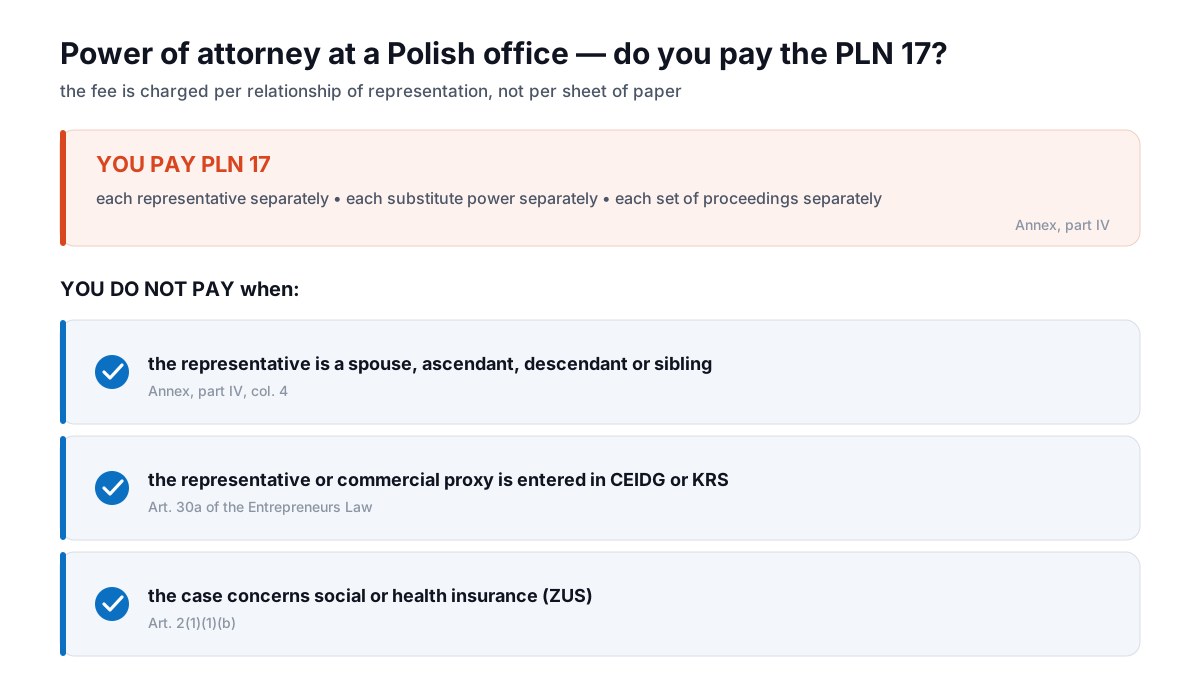
Here lies the most common mistake. The fee is PLN 17 for each relationship of representation, not for the document filed. Part IV of the Annex to the Act says it plainly: for each relationship of representation (or commercial proxy).
In practice:
- three representatives in one case → 3 × PLN 17, even if all of them are named in a single document,
- a power of attorney and a substitute power → PLN 17 for each,
- the same power of attorney filed in several sets of proceedings → the fee is charged separately for each.
You pay for filing the document in a particular case, not for granting the power before a notary. Signing a power of attorney creates no payment obligation on its own.
When you do not pay the PLN 17
The Annex exempts, among others, a power of attorney granted to a spouse, ascendant, descendant or sibling — that is a husband, wife, children, parents, grandparents, grandchildren and siblings. Also exempt is a notarially certified power authorising only the collection of documents, and a general power of attorney within the meaning of the Tax Ordinance.
A second route, often overlooked: if the representative or commercial proxy is entered in CEIDG (the business activity register) or in the KRS register of entrepreneurs, the document need not be filed at all — the office or court checks the register itself and records this in the file by way of an annotation. No document is filed, so no duty arises.
A third: cases concerning social and health insurance, that is proceedings before ZUS, are excluded from stamp duty altogether (Art. 2(1)(1)(b)) — the power of attorney included.
Who has to pay? The rules do not settle it. It may be the principal or the representative, and the tax authority may demand payment from either of them on the basis of joint and several liability. It is worth stating in the contract with your representative who bears the fees.
The rates that come up most often in our cases
All amounts are taken from the Annex to the Act as consolidated on 23 October 2026:
| Act | Stamp duty |
|---|---|
| Filing a power of attorney or commercial proxy — per relationship | PLN 17 |
| Temporary residence and work permit (Art. 114), EU Blue Card (Art. 127), intra-corporate transfer | PLN 440 |
| Amendment of a temporary residence and work permit (Art. 120(1)) | PLN 220 |
| Temporary residence permit — seasonal work (Art. 185a) | PLN 170 |
| Temporary residence permit — short-term stay (Art. 181(1)) | PLN 85 or PLN 340 |
| Permanent residence permit | PLN 640 |
| EU long-term resident’s permit | PLN 640 |
| Other certificates | PLN 17 |
| Certification of a copy — per page started | PLN 5 |
| Confirmation of registration as an active or exempt VAT payer | PLN 170 |
| Decision on development and land-use conditions | PLN 598 |
Two things are confused most often. First, the stamp duty on a permit is not the same as the fee for issuing the residence card — these are two separate transfers to two different institutions. Second, the fee for a work permit (from PLN 200 to PLN 800 depending on the type) is a third, separate payment, made by the employer as the applicant, not by the foreign national.
An application for entry or amendment of an entry in CEIDG is not subject to stamp duty at all. Also exempt are cases concerning the residence of EU, EEA and Swiss citizens and their family members, and cases on international protection, asylum, humanitarian stay and tolerated stay.
Where the money goes
The most common error is: “to the tax office”. No.
“You do not pay stamp duty at the tax office. You pay it into the account of the city or municipal office in whose area the office or other institution where you are filing the application is located.”
Filing a residence card application at the Mazovian Voivodeship Office in Warsaw? The fee goes to the account of the City of Warsaw — not to the voivodeship office and not to the tax office.
For a power of attorney the rule is different and depends on how you file it:
- on paper — to the account of the municipality in whose area the office where you file the power of attorney is located;
- electronically, e.g. through eUrząd Skarbowy — to the account of the municipality competent for the principal’s place of residence or registered office;
- with several principals — the one who has a residence or seat in Poland and is named first in the document;
- where no principal lives in Poland — to the account of the City of Warsaw, Taxpayer Service Centre. That last one covers a good share of cases involving foreign nationals and foreign companies.
Always take the account number from that particular municipality’s own website — there is no single universal account.
Refunds — faster since October 2026
If you paid and the office performed no act, issued no certificate and no permit, the duty is refundable on your request (Art. 9(1) and (2)). There is no official form — you write the request in any form and file it with the mayor of the municipality or city, that is wherever the money went.
Something most guides do not yet mention: since 1 October 2026 new paragraphs 2a–2c of Art. 9 have applied. Where the request is well founded, the tax authority refunds the duty without issuing a decision, within 2 months of the request. And if it is late — interest at the rate of default interest on tax arrears runs from the day the request was filed. Previously a refund required a decision and could drag on.
The hard limit: the duty is not refundable after five years, counting from the end of the year in which it was paid (Art. 9(3)).
What this means for you
If you are a foreign national:
- When filing a residence application, prepare two or three transfers at once: the stamp duty on the permit, PLN 17 for the power of attorney (if you appoint anyone) and — after the decision — the fee for the residence card itself.
- Attach the proof of payment straight away or deliver it within 3 days. A demand for PLN 17 ignored for 7–14 days ends in the return of the application, and with it goes the legality of stay that timely filing had given you.
- Appointing your spouse or sibling? You pay nothing — you only need to state the relationship.
- In ZUS matters (800+, allowances, pensions) a power of attorney is entirely free of the duty.
- If you do not live in Poland and file the power of attorney electronically, your payment goes to Warsaw — the single most misunderstood point.
If you employ foreign nationals:
- The work permit fee is paid by the entity entrusting the work, because it is the party to the proceedings. Do not pass it on to the employee or deduct it from wages.
- If your employee acts through one of your HR staff as representative, remember the PLN 17 per relationship of representation — and that one power of attorney used in three sets of proceedings means three fees.
- A commercial proxy or representative entered in the KRS or CEIDG need not file the document — saving both the fee and one item on the list of missing papers.
- Settle in the contract with your representative who pays: liability is joint and several, so the tax authority may turn to either side.
Not sure how much to pay, or whose account it goes to — or have you received a demand to top up the fee? Write to us — we reply within one business day, in Polish, English and Spanish. We will check the type of your permit and tell you how many transfers to make and where, so that the office does not send your application back.
Based on: Act of 16 November 2006 on stamp duty (consolidated text, Dz.U. 2026 item 1395), Art. 1, 2, 6, 7, 8, 9 and the Annex, parts I–IV; Act of 29 May 2026 amending the Tax Ordinance and certain other acts (Dz.U. 2026 item 846), Art. 14 — Art. 9(2a)–(2c) added, in force since 1 October 2026; Act of 12 December 2013 on Foreigners; Art. 30a of the Act of 6 March 2018 — Entrepreneurs Law; regulation of the Minister of Family, Labour and Social Policy of 20 November 2025 on fees relating to applications for work permits (Dz.U. 2025 item 1622). Quotations and the description of the procedure after biznes.gov.pl, “Kiedy trzeba zapłacić opłatę skarbową” (https://www.biznes.gov.pl/pl/portal/0087), made available under the CC BY-NC-ND 4.0 PL licence; the rates we checked directly in the Annex to the Act. Legal status as at 11 November 2026. This article is for information only and is not legal advice in an individual case.