New ZUS sickness insurance cap. Paying the maximum just before sick leave won't pay off
From 2027 the base for voluntary sickness insurance reaches PLN 25,082.50. A higher contribution does not mean a higher benefit at once — here is why.

From 1 January 2027 self-employed people and contractors under a contract of mandate (umowa zlecenia) can pay voluntary sickness insurance on a base of up to PLN 25,082.50 a month. The maximum sickness contribution will then be PLN 614.52. But anyone who declares the top amount a month before giving birth or a planned operation will not get a high benefit — the Sickness Benefits Act makes the base “grow” over a full year. Below we explain how it works and run the numbers on an example.
The new cap on the contribution base in 2027
The Communication of the President of ZUS (Zakład Ubezpieczeń Społecznych, the Social Insurance Institution) of 5 November 2026 (M.P. 2026 item 1120) states that from 1 January to 31 December 2027 the contribution base for voluntary sickness insurance may not exceed PLN 25,082.50 a month. That is 250% of the forecast average wage (Art. 20(3) and (4) of the Social Insurance System Act). In 2026 the cap is PLN 23,550, so it rises by PLN 1,532.50, or about 6.5%.
The sickness contribution is 2.45% of the base (Art. 22(1)(3)).
| 2026 | 2027 | |
|---|---|---|
| Maximum base for voluntary sickness insurance | PLN 23,550.00 | PLN 25,082.50 |
| Sickness contribution on the maximum base | PLN 576.98 | PLN 614.52 |
| Minimum wage (gross) | PLN 4,806 | PLN 4,950 |
| Preferential ZUS — base (30% of the minimum wage) | PLN 1,441.80 | PLN 1,485.00 |
| Sickness contribution under preferential ZUS | PLN 35.32 | PLN 36.38 |
| Lowest base under full ZUS for a business (60% of the forecast average wage) | PLN 5,652.00 | PLN 6,019.80 |
The Art. 48a trap: sickness benefit builds up over 12 months
Under ZUS rules for business owners, the entrepreneur declares the contribution base themselves. The law has a safeguard for this. If a person with a declared base has been covered by sickness insurance for less than 12 months, the benefit base is not equal to the declaration. Under Art. 48a(1) of the Sickness Benefits Act it is the sum of two parts:
- the lowest contribution base that applies to that person,
- 1/12 of the excess of the declared amount over that lowest base, multiplied by the number of full months of insurance.
The same rule covers maternity benefit and care benefit (Art. 52). Exception under Art. 48a(2): if before joining you were covered by sickness insurance under another title, e.g. an employment contract, and the gap did not exceed 30 days, full months from the previous title count too, up to 12 in total.
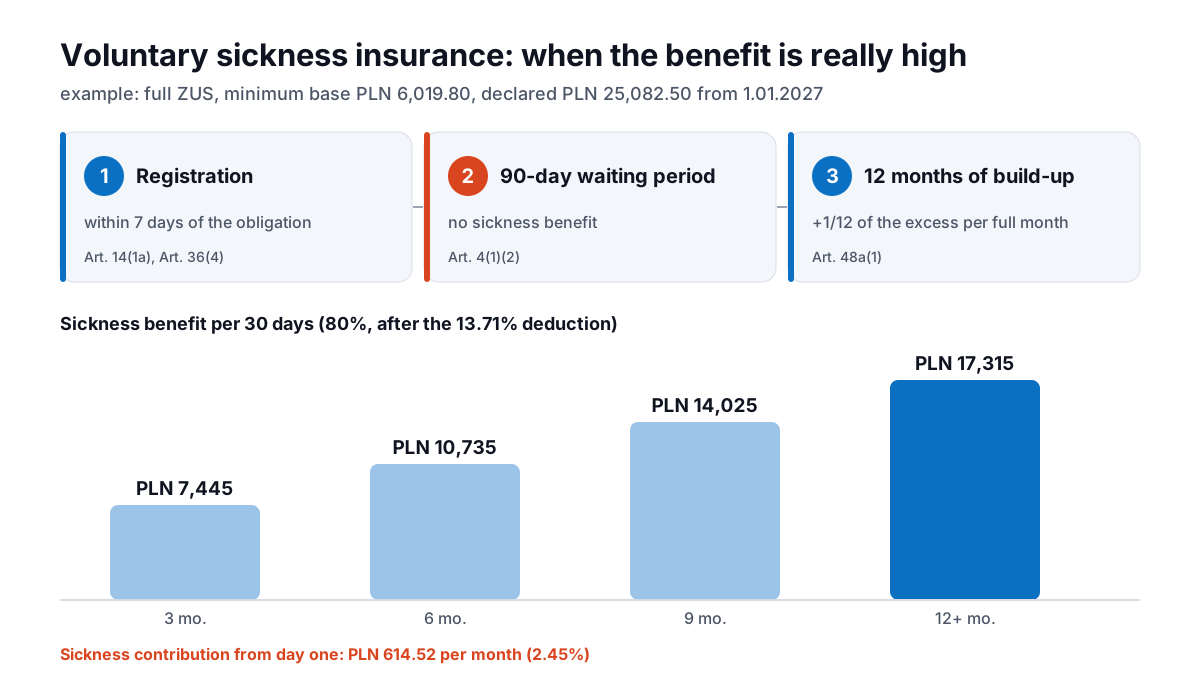
Example. An entrepreneur on full ZUS (lowest base in 2027: PLN 6,019.80) joins sickness insurance on 1 January 2027 and immediately declares PLN 25,082.50. Sickness benefit is 80% of the base, and 13.71% is deducted from the base (Art. 3(4) and Art. 11(1)):
| Full months of insurance | Benefit base (before deduction) | Sickness benefit per 30 days (80%) |
|---|---|---|
| 3 | PLN 10,785.48 | approx. PLN 7,445 |
| 6 | PLN 15,551.15 | approx. PLN 10,735 |
| 9 | PLN 20,316.83 | approx. PLN 14,025 |
| 12 or more | PLN 25,082.50 | approx. PLN 17,315 |
Yet the PLN 614.52 contribution is paid from the first month. The takeaway: voluntary sickness insurance on a high base has to be chosen at least a year before a planned birth or procedure. There is no shortcut after a year either — Art. 48 takes the average of 12 months, so a one-off increase in the declaration raises the base by only 1/12.
Waiting period: 90 days without sickness benefit
With compulsory insurance, the right to sickness benefit arises after 30 days; with voluntary insurance only after 90 days of uninterrupted cover (Art. 4(1) of the Sickness Benefits Act). Earlier periods of sickness insurance count if the gap did not exceed 30 days (Art. 4(2)). From day one the benefit is available, among others, to graduates who joined within 90 days of finishing school or obtaining their diploma, and for incapacity caused by an accident on the way to or from work (Art. 4(3)). The waiting period applies to sickness benefit, not maternity benefit. We describe how sick notes are issued and checked in our article on sick leave (L4).
Registration deadline and what happens if you are late
Voluntary sickness insurance starts on the date stated in the registration form, but not earlier than the day it is filed with ZUS (Art. 14(1) of the Social Insurance System Act). Cover from an earlier date is possible only if registration for pension and disability insurance was made on time: within 7 days of the obligation arising (Art. 14(1a) read with Art. 36(4)). An entrepreneur who started or resumed business in January and pays income-based contributions (“mały ZUS plus”) has until the end of January (Art. 36(4b)).
Few people know about a second change: since 1 January 2022 Art. 14(2)(2) has been repealed. Failing to pay the contribution on time no longer automatically ends voluntary sickness insurance. The insurance continues, and the contribution must be settled for every month (Art. 14(2a)). An unpaid contribution does not disappear — it becomes a debt owed to ZUS.
Contractors and foreign nationals: sickness insurance is not automatic
Under a contract of mandate, sickness insurance is voluntary (Art. 11(2)). The contractor has to ask to join, and the principal registers them as the contribution payer. Without it, they will get neither sickness benefit nor maternity benefit, even if they have paid pension and disability contributions for years. A separate issue, unrelated to sickness insurance, is counting a contract of mandate towards seniority. Art. 48a does not apply to contractors, because their base is the income from the contract, not a declared amount. The PLN 25,082.50 cap and the 90-day waiting period apply to them just the same.
You can join sickness insurance only if the contract makes you compulsorily subject to pension and disability insurance. A pupil or student under 26 working under a contract of mandate is not subject to that insurance (Art. 6(4)), so cannot join sickness insurance under that contract either. Exception: a contract concluded with your own employer or performed for that employer (Art. 6(4b)).
A foreign national’s residence status does not matter here. Art. 6(1) covers natural persons who in the territory of Poland are employees, contractors or entrepreneurs — with no citizenship requirement. What counts is the insurance title, not the passport or the type of residence card.
What this means for you
If you run a business or work under a contract of mandate:
- Planning a child or a procedure? Join sickness insurance and raise the base at least 12 months in advance.
- Register within 7 days of starting the business or the contract. Being late moves the start of cover to the day the form is filed.
- For the first 90 days you will not receive sickness benefit — unless earlier cover with a gap of up to 30 days counts.
- On a contract of mandate, check your ZUS account to see whether you have sickness insurance at all.
If you hire on contracts of mandate:
- Ask about sickness insurance when the contract is signed, foreign workers included — in a language they understand. Keep the request on file.
- Register within 7 days. Your delay can cost the contractor their benefit.
- Watch a student’s 26th birthday: from that day the insurance obligation arises, and with it the option to join sickness insurance.
Have a question about contractors’ insurance or employing foreign nationals? Write to us — we reply within one business day, in Polish, English and Spanish.
Based on: Communication of the President of ZUS of 5 November 2026 (M.P. 2026 item 1120); Communication of the President of ZUS of 28 November 2025 (M.P. 2025 item 1216); Notice of the Minister of Family, Labour and Social Policy of 3 November 2026 (M.P. 2026 item 1098); Act of 13 October 1998 on the social insurance system (ustawa o systemie ubezpieczeń społecznych, consolidated text Dz.U. 2026 item 1474), Art. 6(1) and (4)–(4b), Art. 11, Art. 14, Art. 18(8), Art. 20(3)–(4), Art. 22(1), Art. 36(4) and (4b); Act of 24 June 2021 (Dz.U. 2021 item 1621), Art. 1(4); Act of 25 June 1999 on cash benefits from social insurance in case of sickness and maternity (ustawa o świadczeniach pieniężnych z ubezpieczenia społecznego w razie choroby i macierzyństwa, consolidated text Dz.U. 2026 item 854), Art. 3(4), Art. 4, Art. 11(1), Art. 48, Art. 48a, Art. 52; Council of Ministers regulations on the minimum wage (Dz.U. 2025 item 1242 and Dz.U. 2026 item 1213). The starting point was the article “Dobrowolne ubezpieczenie chorobowe 2027. Nowy limit ZUS dla przedsiębiorców” by Marta Borysiuk, Gazeta Prawna. The calculations are illustrative: during pregnancy the benefit rate is 100%, and ZUS may determine the lowest base differently, e.g. under preferential ZUS. Legal status as at 11 November 2026. This article is for information only and is not legal advice in an individual case.