
The EU allows 90 days for a decision — in Poland it takes up to 658
The deadline to implement the single-permit directive expired on 21 May 2026. See what already works, what is missing and what to do when your case stalls.
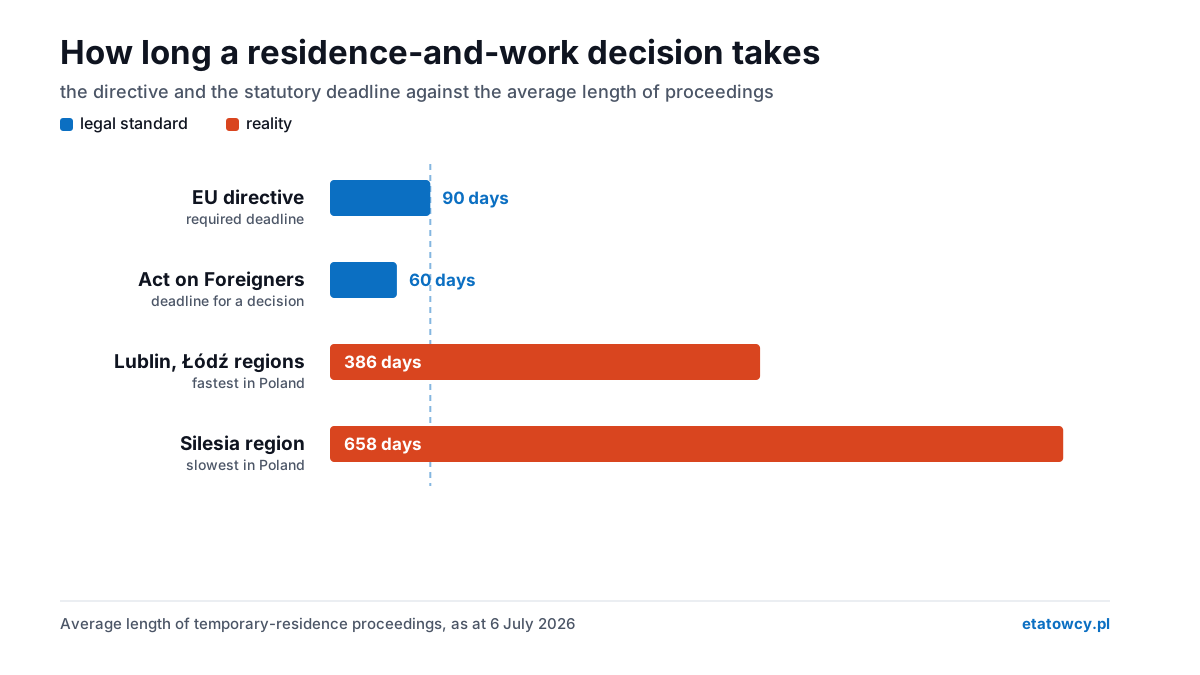
The EU directive requires a decision on a single residence-and-work permit within 90 days. In ten of Poland’s sixteen regions the procedure now takes over a year, and in Silesia an average of 658 days. The deadline for implementing the rules expired on 21 May 2026, Poland missed it, and is among seventeen member states formally called on by the European Commission to make up the shortfall. Here is what already applies, what is missing, and what a worker whose case is stuck can actually do.
What the directive requires
Directive (EU) 2024/1233 of 24 April 2024 replaces the earlier Directive 2011/98/EU, which ceased to apply on 22 May 2026. Its key requirements:
- A decision within 90 days of a complete application — and importantly, that deadline also covers the labour-market test where one is carried out (Art. 5(2)). In particularly complex cases it may be extended by 30 days, and by 15 days when the holder changes employer.
- Protection after losing a job: the permit may not be withdrawn for at least 3 months of unemployment, or 6 months if the person has held the single permit for more than two years. For unemployment longer than three months, a state may require proof of sufficient resources.
- The right to change employer under defined conditions.
- The option to apply from abroad, not only from the territory of the host state.
The directive also strengthens protection against exploitation: it requires monitoring, inspections, complaint mechanisms and penalties.
What already works in Poland
Quite a lot. Poland has had the basic structure the directive calls for for years:
- the temporary residence and work permit combines the right to stay and the right to work in a single decision — that is the “single permit”,
- proceedings are handled by one authority — the voivode (regional governor) issues one decision covering both aspects,
- the application may be filed from within Poland, without returning to the country of origin, and once started, the procedure continues even if the applicant travels abroad.
As Michał Wysłocki of the EY Poland Immigration team, an ABSL expert, notes, this matches the single-application procedure the directive envisages.
What is missing
The deadline — and when it starts running
Polish law provides 60 days for a decision on a temporary residence permit (Art. 112a(1) of the Act on Foreigners) — formally less than the EU’s 90. The problem lies elsewhere.
Under Art. 112a(2), the Polish clock starts only on the day of the last of these events: filing an application free of formal defects (or remedying them), or submitting the required documents. The directive, by contrast, counts 90 days from a complete application. The difference looks subtle, but it decides when the clock starts at all — and where the authority calls for missing documents, it may start many months after the papers were filed.
Then comes the thing that matters most: the actual length of proceedings. According to figures cited in the report “Legalisation of residence in Poland 2026–2031: chaos that can be avoided” (as at 6 July 2026), in ten of sixteen regions a temporary-residence case took on average over a year — from 386 days in the Lublin and Łódź regions to 658 days in Silesia. At the Mazovian Voivodeship Office, 41% of the 26,877 residence decisions issued in 2023–2026 came after more than twelve months.
A separate matter is the special legislation that formally suspends the running of deadlines in many residence cases until 4 March 2027 — although the scope of those provisions is contested before the administrative courts.
Protection after job loss — 30 days instead of three months
Here the gap is plain. The Polish rules work like this:
- After losing your job you have 15 working days to notify in writing the voivode who issued the permit (Art. 121(1)). The duty is also satisfied if, within the same period, you file an application to amend the permit (Art. 121(3)).
- If you meet that duty, for 30 days from the loss of work the permit cannot be withdrawn on the ground that the purpose of stay has ceased (Art. 123(1)).
- The protection applies only once during the whole validity of the permit (Art. 123(2)).
The directive requires three months, and six where the permit has been held for over two years. Poland’s 30 days is clearly less.
There is, however, an exception worth knowing. For permits granted for work in an occupation desirable for the Polish economy (Art. 114(1a)), the protection already lasts 3 months and may be used twice during the permit’s validity (Art. 123(3)). If your permit was issued on that basis, a standard close to the EU one already covers you.
The employer’s own duty
This is less often remembered: the entity entrusting work that is named in the permit has 15 days to notify the voivode in writing that the foreign national has lost their job there (Art. 121(4)). That duty is separate from the worker’s.
Applying from abroad
The directive requires that an application for a single permit can also be examined for someone outside the host state. In Poland a person recruited from abroad first obtains a work visa and only applies for the residence-and-work permit after arriving. These are two separate procedures — and that is precisely where the question arises whether the Polish model can count as a single procedure within the meaning of the directive.
What you can do when a case stalls
The failure to implement the directive does not suspend Polish rules — they still apply. But you have tools:
A formal reminder (ponaglenie). If the authority fails to deal with the case on time or conducts it with undue delay, you may lodge a ponaglenie with the higher authority through the one handling your case (Art. 37 of the Code of Administrative Procedure). It is a precondition for a later complaint to the administrative court about inaction.
Invoking the directive. Once the transposition deadline has passed, an individual may — under the settled case law of the Court of Justice of the EU — rely against the state on those provisions of a directive that are sufficiently clear, precise and unconditional. This is no guarantee of an outcome, but it can serve as an argument in a ponaglenie or a complaint. Whether it works in a given case depends on its circumstances and on which provision is at stake.
Keeping your own deadlines. Whatever the delays at the office, your deadlines run normally: 15 working days to report a job loss, and an application for a further permit no later than the last day of your legal stay.
What this means for you
If you are an employee:
- Lost your job? Notify the voivode within 15 working days — or file an application to amend the permit in the same period. Without that you do not even get the 30 days of protection.
- Remember the protection works only once during the permit’s validity. On a second job loss there will be none — unless your permit was issued for an occupation desirable for the Polish economy.
- Case pending over a year? Consider a ponaglenie. It does not speed things up automatically, but it opens the way to a complaint about inaction.
- Do not leave the application for your next permit to the last moment — with queues like these, a margin is your only protection.
If you employ foreign nationals:
- You have your own, separate duty: 15 days to notify the voivode that a foreign national named in the permit has lost their job with you.
- When planning recruitment from abroad, count the real duration in your region, not the statutory deadline. The gap between 60 and 658 days decides the start date.
- Implementing the directive, once it happens, should extend protection after job loss — giving you more time to hire someone already in Poland rather than bringing in another person from abroad.
- Changing the rules alone will not shorten the queues. Without resources and working tools on the authorities’ side, the new deadlines will stay on paper.
Running a case that has dragged on for months, or unsure whether your worker kept continuity of legal stay after changing jobs? Write to us — we reply within one business day.
Based on: Directive (EU) 2024/1233 of the European Parliament and of the Council of 24 April 2024 on a single application procedure for a single permit (OJ L 2024/1233, 30.4.2024), Art. 5(2), Art. 18(1), Art. 19 and recitals 25 and 45; Act of 12 December 2013 on Foreigners (consolidated text, Dz.U. 2025 item 1079), Art. 101, 112a, 114(1a), 121, 122, 123; Act of 14 June 1960 — Code of Administrative Procedure, Art. 37. Figures on the length of proceedings, the Commission’s formal call on Poland and the expert’s comments after “Unijne 90 dni kontra polskie dwa lata. Polska spóźniona z kluczową dyrektywą migracyjną”, Patrycja Otto, Gazeta Prawna, 7 October 2026. Legal status as at 16 October 2026.