
How much a bailiff can take in 2027 — PLN 3,703.93 is protected
From January a bailiff must leave you PLN 3,703.93 net. See how much is taken at your salary level, and how maintenance, civil contracts and part-time work change it.
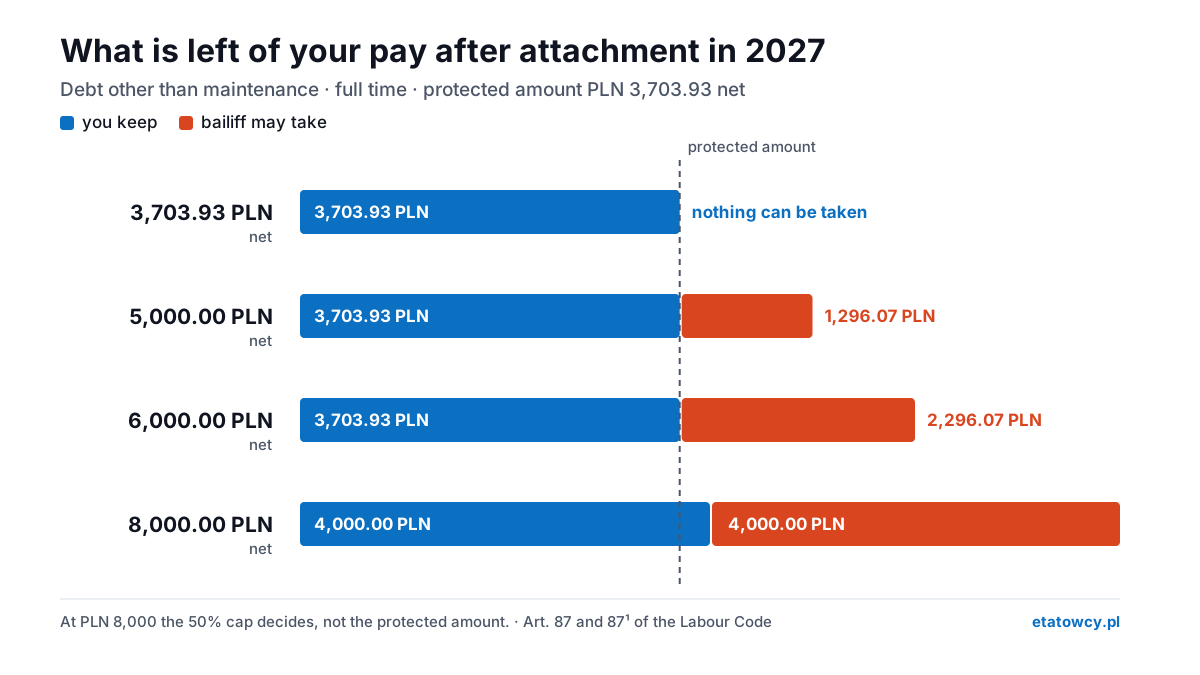
From 1 January 2027 a bailiff enforcing an ordinary debt against your salary must leave you roughly PLN 3,703.93 net per month. That is almost PLN 100 more than in 2026, because the protected amount is tied to the minimum wage, which rises to PLN 4,950 gross. Here is what actually stays in your account at different salary levels, why maintenance works differently, and what to do when too much disappears from your pay.
Where PLN 3,703.93 comes from
The Labour Code does not state this figure directly. Article 87¹ § 1 says that when enforcing debts other than maintenance, a full-time employee must be left the equivalent of the minimum wage after deduction of contributions and the income-tax advance — in other words, the minimum wage “in hand”.
From January 2027 the minimum wage is PLN 4,950 gross (Council of Ministers regulation of 14 September 2026). On typical terms — full time, aged over 26, PIT-2 filed, standard tax-deductible costs, no PPK (employee capital plan) — that works out at PLN 3,703.93 net. That is what must remain yours.
If your situation differs, so does the amount:
- you pay into PPK — the protected amount is lower, because your net pay is lower,
- you are under 26 and use the zero-PIT relief — it is higher,
- you work part time — the protected amount is reduced in proportion to your working time (Art. 87¹ § 2). On a half-time contract it is about half, on three-quarters — about three-quarters.
Two limits apply at the same time
For an ordinary debt — a loan, a credit card, an unpaid bill — the bailiff is bound by two limits at once:
- a percentage cap — no more than half of your pay may be taken (Art. 87 § 3),
- the protected amount — PLN 3,703.93 must be left to you (Art. 87¹ § 1).
Whichever is more favourable to you prevails. At lower salaries the protected amount usually decides; at higher ones, the half-of-pay cap.
| Your net pay | You keep | Bailiff may take | What decided |
|---|---|---|---|
| PLN 3,703.93 | PLN 3,703.93 | PLN 0 | protected amount |
| PLN 5,000 | PLN 3,703.93 | PLN 1,296.07 | protected amount |
| PLN 6,000 | PLN 3,703.93 | PLN 2,296.07 | protected amount |
| PLN 8,000 | PLN 4,000 | PLN 4,000 | 50% cap |
At PLN 8,000 net the protected amount alone would allow PLN 4,296.07 to be taken — but the half-of-pay cap stops enforcement at PLN 4,000. This is also why someone earning the minimum wage loses nothing at all from their pay to an ordinary debt.
Maintenance: the protection does not apply
For maintenance (alimony) the rules are different and much tougher:
- up to three fifths of pay (60%) may be taken, not half,
- the protected amount does not apply — Art. 87¹ § 1 does not provide for it in maintenance cases.
In practice an employee on the minimum wage can lose 60% of their pay to a maintenance bailiff, even though an ordinary debt would take nothing.
Other deductions people forget about
A bailiff’s attachment is not the only thing that shrinks a payslip. The Labour Code sets its own protected amounts for the remaining deductions, calculated from the same net minimum wage:
- cash advances paid by the employer — 75% of the protected amount stays with you,
- financial penalties (health and safety, alcohol, unexcused absence) — 90%,
- deductions with your written consent in favour of the employer, e.g. for company accommodation — 100% of the protected amount,
- deductions with consent in favour of someone else, e.g. a loan instalment — 80% (Art. 91 § 2).
We covered this in detail in Deductions from pay — what your employer may take and how much must be left.
What if you work on a civil contract?
There is a widespread belief that a bailiff can take everything from an umowa zlecenie (civil contract). That is not true — at least not always.
Article 833 § 2¹ of the Code of Civil Procedure requires the rules protecting employment pay to be applied accordingly to recurring payments intended to provide a livelihood, or constituting the debtor’s sole source of income. So if the contract is performed regularly, the payment arrives monthly and it is your only income, the protected amount shields you just as it would on an employment contract.
For the protection to work, the bailiff has to know about it. If an attachment has swallowed your entire payment and that contract is your only means of support, write to the bailiff and prove it — with the contract, your transfer history or a statement from the principal.
What a bailiff cannot touch at all
Regardless of your salary, enforcement does not reach, among others, family benefits, the child-raising benefit (800+), the “Good Start” benefit, the shielding allowance, the energy voucher, the supporting benefit, social assistance benefits and “Active Parent” benefits (Art. 833 § 6 CCP). If such money has landed in an attached account, report it to the bank and the bailiff.
The employer’s duties — and the fine for ignoring them
The attachment goes not to you but to your employer. Once it arrives, the employer has one week to give the bailiff a three-month breakdown of your pay, state the amounts and dates of the deductions, and report any obstacles or competing attachments (Art. 882 § 1). From that moment the attached part may not be paid out to you (Art. 881 § 3).
An employer who fails to do this, submits an untrue statement, or pays the money to the employee despite the attachment faces a fine of up to PLN 5,000 — which is repeated if the failure continues, plus liability to the creditor for the resulting damage (Art. 886 § 1 and 3). The fine also reaches the member of staff responsible for the task, and where none was designated — the people authorised to represent the employer (Art. 886 § 2).
A note for employees: the same fine applies to a debtor who fails to notify the bailiff of a change of employer (Art. 886 § 4).
When too much has gone from your pay
Deductions sometimes exceed what the law allows — because the employer calculated the protected amount from gross instead of net pay, ignored part-time status, or applied maintenance rules to an ordinary debt.
What you can do:
- Ask your employer for the calculation — they must show how they arrived at the figure. Often that is enough for the error to be corrected with the next payslip.
- Write to the bailiff, stating what protected amount applies to you and why.
- File a complaint against the bailiff’s action with the district court for the seat of their office — you have one week from the action or from being notified of it (Art. 767 § 1 and 4). An official form may be used, and the bailiff must inform you of this option at the first enforcement step.
- Report it to the National Labour Inspectorate (PIP) if it is the employer deducting without a basis — for example for accommodation without your written consent.
What this means for you
If you are an employee:
- On the minimum wage and a full-time contract? An ordinary debt takes nothing from you — but maintenance can still take up to 60%.
- Check your January 2027 payslip: the protected amount should rise from about PLN 3,605 to PLN 3,703.93. If the deduction has not changed, ask your HR department.
- Working on a civil contract that is your only income? The protection applies — but you must demonstrate it to the bailiff.
- A foreign national? The rules are exactly the same as for Polish citizens. If you live in accommodation provided by an agency, check that the charge is not deducted beyond the protected amount.
If you are an employer:
- Recalculate the protected amounts for every attachment from the January 2027 payroll — separately for part-time staff.
- Watch the one-week deadline for the statement to the bailiff; the PLN 5,000 fine is repeatable.
- Where several attachments compete, transfer deductions to the bailiff, not directly to creditors (Art. 881 § 3 point 2).
- Do you have temporary staff on civil contracts? Check that the protection under Art. 833 § 2¹ CCP is not being overlooked.
If you are unsure whether a deduction from your pay is correct — or you run a company and want your attachment handling checked — write to us. We reply within one business day.
Based on: Act of 26 June 1974 — Labour Code (consolidated text, Dz.U. 2026 item 1245), Art. 87, 87¹, 91, 108; Act of 17 November 1964 — Code of Civil Procedure (consolidated text, Dz.U. 2026 item 468, last amended Dz.U. 2026 item 830), Art. 767, 833, 881, 882, 886; Council of Ministers regulation of 14 September 2026 on the minimum wage and the minimum hourly rate in 2027 (Dz.U. 2026 item 1213). The net figure of PLN 3,703.93 after “Ile pensji zabierze komornik w 2027 r.? Kwoty wolne od potrąceń”, Gazeta Prawna, assuming full-time work, age over 26, PIT-2 filed, standard deductible costs and no PPK. Legal status as at 13 October 2026.